The Backstory of VAM
Can You Share about a Defining Moment In your Career?
I was biking home from a lecture on concussions in my third year of physical therapy school at UCSF when I saw a car coming at me at full speed. The next thing I remember, I was somewhere else entirely: enveloped in a warm white light, a feeling of complete safety, a presence I did not want to leave. It felt like eternity. Blissful. Whole. And then the voices grew louder. Sirens. The clinical knowledge from the lecture I had just come from rising up instinctively: this is the essential moment to “come back.” I made the difficult decision and returned to my body.
The euphoria ended harshly. The driver, uninsured, had left the scene. My neighbors were gathering my groceries from the intersection, asking for my name, my emergency contact, whether I was hurting. I was loaded into an ambulance and taken to San Francisco General Hospital.
The trauma ward was overflowing. My cot was in the hallway. I did not fully understand my own condition until a woman who had been screaming in the room next to me walked into the hallway, took one look at me, and gasped. That was when I knew. I tried to get up to find a mirror. Nurses rushed toward me telling me my ankle was broken. I looked down at a hematoma the size of a softball and kept walking.
What I saw in the mirror made me want to be sick. My face was unrecognizable: swollen, gashed to the bone through my right eyebrow, road rash up my neck. They got me back to my cot to wait for the plastic surgeon.
The timing could not have been worse. I was one week from presenting my doctoral dissertation on guided imagery and its use in physical therapy to affect pain, self-efficacy, and functional outcomes. I had a manuscript to edit and slides to finalize. I had requested no pain medication because my reaction to it is worse than the pain itself.
When the surgeon arrived and asked again about medication, I said no. I closed my eyes and imagined a vine, slowly and deliberately stitching my face back together. The surgeon was visibly unsettled. I told her I was okay and kept my attention on the vine.
A week later I gave my dissertation presentation with a black eye and fresh stitches, the most honest visual aid I could have asked for. The imagination is powerful. It belongs in how we treat pain.
I passed my Boards, finished my ICU rotation, graduated, and traveled to Indonesia to immerse myself in yoga and Ayurveda. I had enrolled in a yoga teacher training before the accident because I wanted another perspective on healing. I never would have guessed that this would be where I found the rest and space to begin healing from a traumatic brain injury. It would be six more years before I sought official help, but what I learned in Bali was an essential component of my recovery. Yoga Nidra, an ancient practice translating to conscious sleep, had been a guided imagery technology for thousands of years. I had just proven its principles on an operating table. I was ready to go deeper.
The long, unglamorous work of re-inhabiting my own body after that accident is what led me back to my soul and to my purpose.
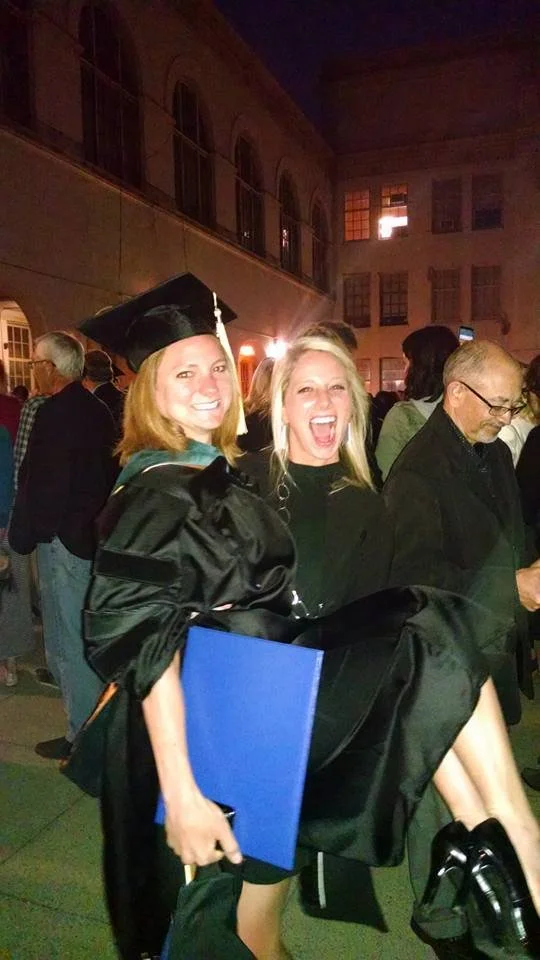
My sister celebrating PT School graduation with me!
Why This Became the Vital Axis Method™
That night in the ER was the first time I proved to myself, inside my own body, that the mind can direct real physiological change. Pain and healing are not purely mechanical. The nervous system will listen if you know how to speak to it.
The Vital Axis Method™ exists because I refuse to separate the body being treated from the mind directing it. Most clinical training addresses tissue, joints, and movement patterns as though they exist apart from attention, imagery, and intention. Eighteen years of clinical practice and my own healing taught me otherwise. The vine stitching me back together was not a distraction from the surgery. It was part of it.
That is the axis: structure and sensation held together by sovereignty, the felt and active belief that you can direct your own healing toward the outcome you actually want. Not passive recovery. Not returning to baseline. Aiming deliberately at full restoration, the way I aimed that vine at closing every centimeter of that wound.
I built this method so my clients could learn what I learned without paying the price I paid.
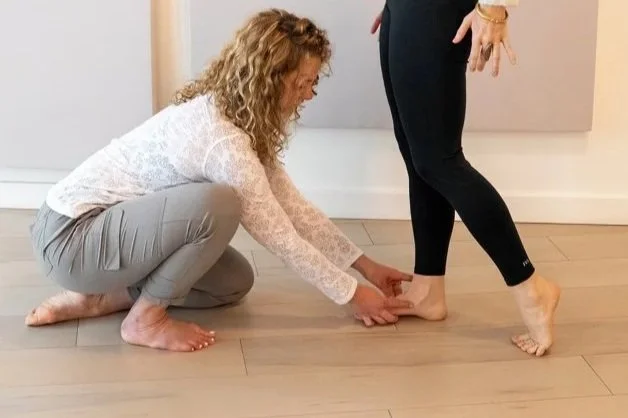
Foot Mechanics Are An Essential Component of Pelvic Floor Therapy.
Before we go further, can you introduce yourself and share how you got to where you are today?
Meet Dr. Valerie Brown, PT, DPT
I am Val, an integrative pelvic floor physical therapist, yoga therapist, and somatic educator based in Portland, Oregon. I am the founder of the Vital Axis Method™ and Align Wellness LLC, and I have spent nearly two decades in clinical practice working across pelvic health, neurology, orthopedics, sports medicine, integrative medicine, oncology, and end-of-life care.
I hold a Doctorate in Physical Therapy with an emphasis in Integrative Medicine and Mind-Body Interventions from UCSF, and a Bachelor of Science in Integrative Physiology with a Neuroscience Certificate from the University of Colorado Boulder. My training spans integrative pelvic health, yoga therapy, functional and lifestyle medicine, craniosacral and visceral manipulation, HeartMath, somatic and emotional release, Kundalini yoga, Yoga Nidra, Reiki, vibroacoustic therapy, Vedic medical Astrology, and Pilates.
My teachers span professions, the globe, and hundreds and thousands of years. Their dedication to their work informs this method, and their generosity made it possible for me to share it in this way.
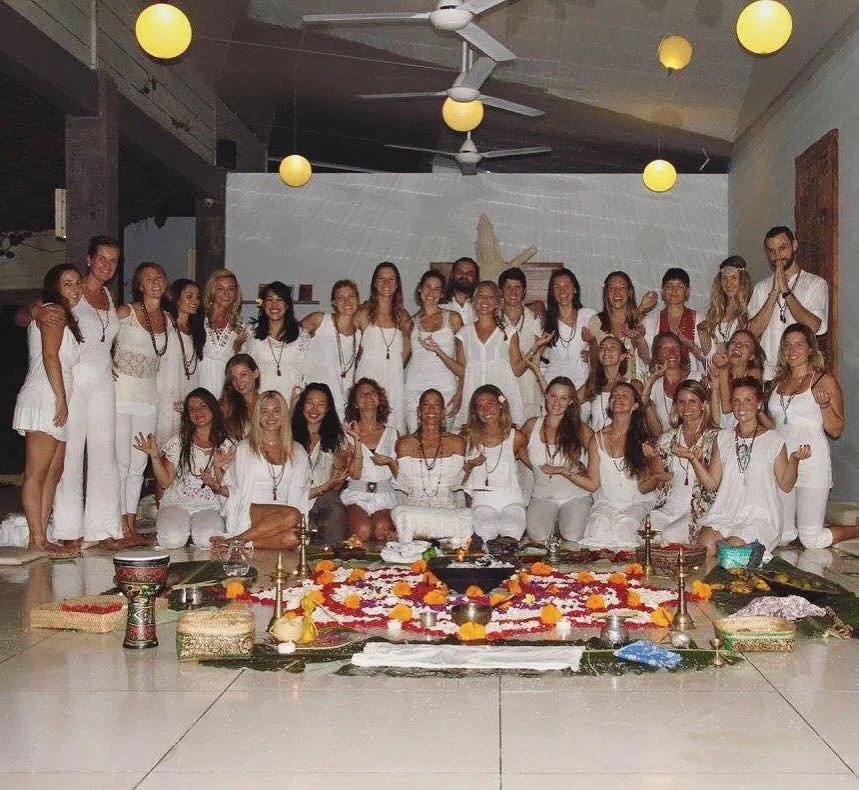
A Photo with my teacher Lily in Indonesia in 2016. Her Yoga Nidra Certification and 200 Hr YTT are incredible.
What I Do
The Vital Axis Method™ is a whole-person pelvic health framework built on three pillars: Structure, Sensation, and Sovereignty. The tagline I keep returning to is "return to your center," because that is ultimately the work: helping women return to a body they may have been taught to override, ignore, or fear.
In practice this means six to twelve week programs across ten specialty tracks covering hip and back pain, pelvic pain, incontinence and prolapse, digestion and gut health, hypermobility, somatic and trauma healing, pleasure and reclamation, perinatal health, trail adventure and athletic training, and neck and shoulder pain. Each track integrates functional movement, breath mechanics, functional nutrition, nervous system regulation, Ayurvedic constitutional mapping, and Yoga Nidra into a program that can be accessed from anywhere.
Tiers of support range from a fully self-guided program beginning at $199 to a three-month immersive container with biweekly sessions and unlimited voice chat support, because some people need a roadmap and the capacity to guide themselves, and some need real-time, in-person partnership. Both are honored here. A practitioner certification track is also in development for yoga teachers, somatic therapists, coaches, and bodyworkers who want to bring this integrated approach into their own practices.
The Problem I Solve
Most of the women who find this work have already been through the conventional system. They have been told their pain is normal, that imaging looks fine, or that the solution is more Kegels, weight loss, or core work. What is almost always missing is not more exercises. It is the connection between the nervous system and the body doing the exercises.
I do not work from a framework of fixing broken women. I work from the premise that the body already knows how to move toward wholeness, and my job is to clear the structural, physiological, and nervous system obstacles so that intelligence can do what it already knows how to do.
What Sets Me Apart
I do not separate the clinical from the somatic from the spiritual, because in my experience they were never actually separate. I bring doctorate-level clinical training and neuroscience to work that also holds space for imagery, nervous system regulation, and embodiment as legitimate, evidence-informed tools, not soft additions to real treatment.
The method holds across completely different bodies and presentations, from postpartum clients to trail athletes to people recovering from trauma that has nothing to do with a physical injury, because the principle underneath it is simple and true. Aim your attention on purpose at the outcome you want, and give your body every reason to trust it is safe enough to get there.
Learning and unlearning are both critical parts of growth. Can you share a story of a time when you had to unlearn a lesson?
I had to unlearn pushing through pain. More specifically, I had to learn to hear my body's warning signals instead of treating them as obstacles to override.
There was a stretch of my life when I was a part-time competitive triathlete, part-time cashier, part-time volunteer, and full-time doctoral student, all simultaneously. It felt like ambition. It was depletion wearing ambition's clothes.
The cost showed up everywhere: my mental and physical health, my relationships, my finances, my spiritual life. I was running on fumes and calling it drive.
Healing meant being forced to slow down, genuinely forced. Slowing down was more uncomfortable for me than running a marathon. Marathons had finish lines. Stillness had nothing to prove I had done it right.
What I practice now is moderation over maximum output and deliberate prioritization over doing everything at once. Before I add anything to my plate I ask whether it belongs to my actual mission, not just whether I am technically capable of taking it on.
It is a lesson I still have to relearn. But I know the warning signs now. And I know that slowing down is not the opposite of ambition. It is what makes ambition sustainable enough to actually arrive somewhere.
Have you ever had to pivot?
On Pivoting
I could blame it on growing up as a dancer. The pivot turn has been a defining shape of my life, on stage and off. In the last decade alone I have moved twenty-four times. Some moves were planned. Others were emergencies: mold in a home, a family medical crisis, the kind of circumstances that give you hours rather than months to pack a life into boxes.
My biggest pivot came right after I landed in pelvic floor physical therapy. I was fresh out of my certification, starting a job that felt exactly aimed at the clients I wanted to serve. Two weeks in, the person I thought I was going to build a life with left. My heart was completely broken.
Getting through a single workday took everything I had. I asked to reduce my hours so I could stay standing. I was let go instead.
In the months that followed I found my way to wise mentors who saw something in me I could not yet see in myself. With the time that job loss handed me, unwanted as it was, I built the courses, the coaching containers, and the framework that would eventually become the Vital Axis Method™. I spent that season trying to name the undefinable thing I actually do, and slowly it came into focus.

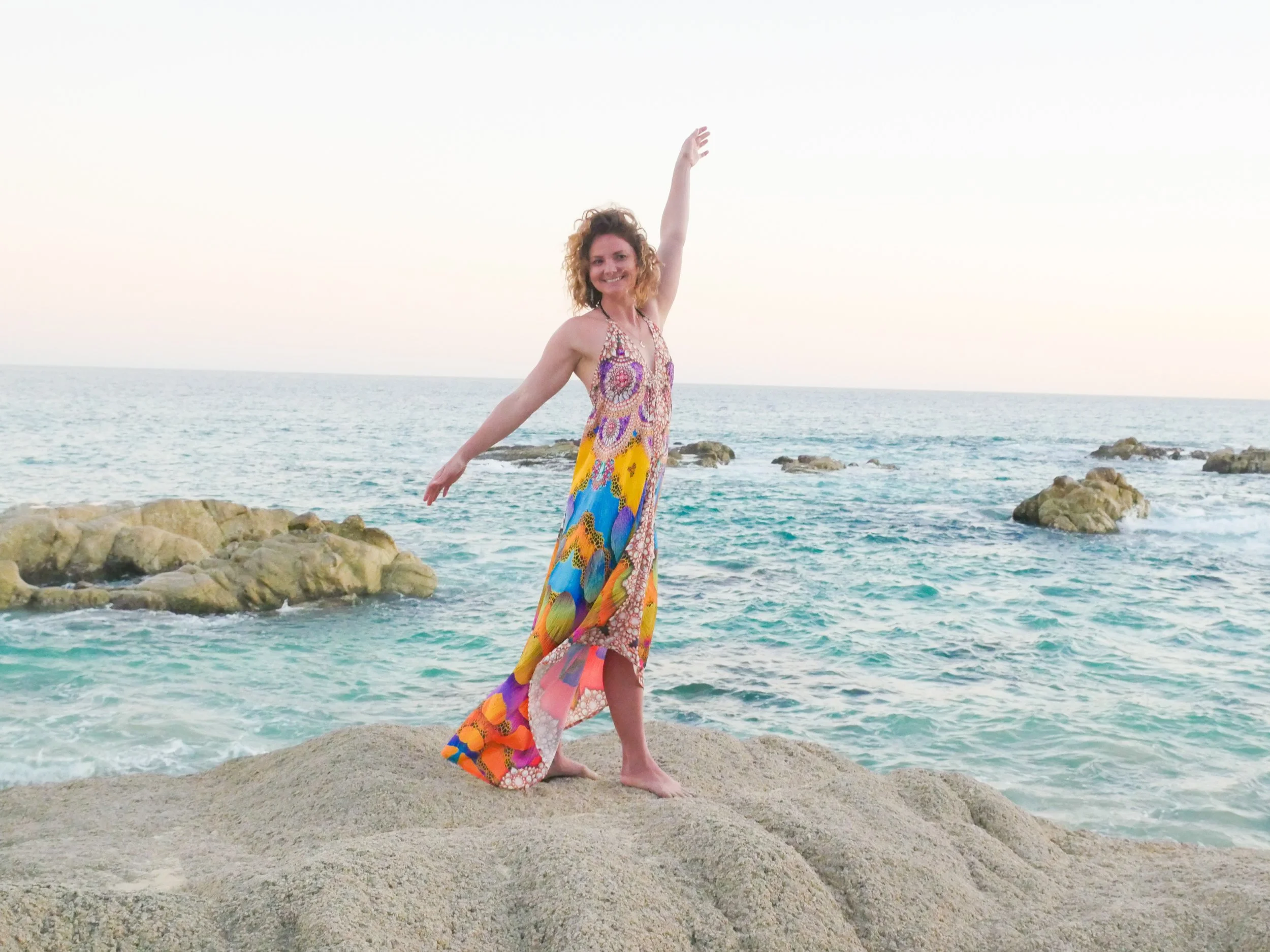
At the Radiant Renewal Retreat in Cabo San Lucas hosted by Dr. Desi Bartlett, PhD, and Dr. Natiya Guin, ND.
I do not believe that job loss was a detour from my path. It was the pivot turn itself, the moment the choreography changed direction because it had to. Sovereignty, one of the three pillars I build everything on, is not something I teach from theory. It is something I have had to practice over and over: through twenty-four moves, broken engagements, and a job I lost when I was already at what felt like rock bottom.
A pivot turn only works because your other foot stays planted. Mine was planted in the work itself, in the conviction that this method matters, even before I had the language or the structure to prove it.
Contact Website: vitalaxispt.com Instagram: @vital.axis.method LinkedIn: linkedin.com/in/dr-valerie-christine-brown-dpt YouTube: youtube.com/@vitalaxispt